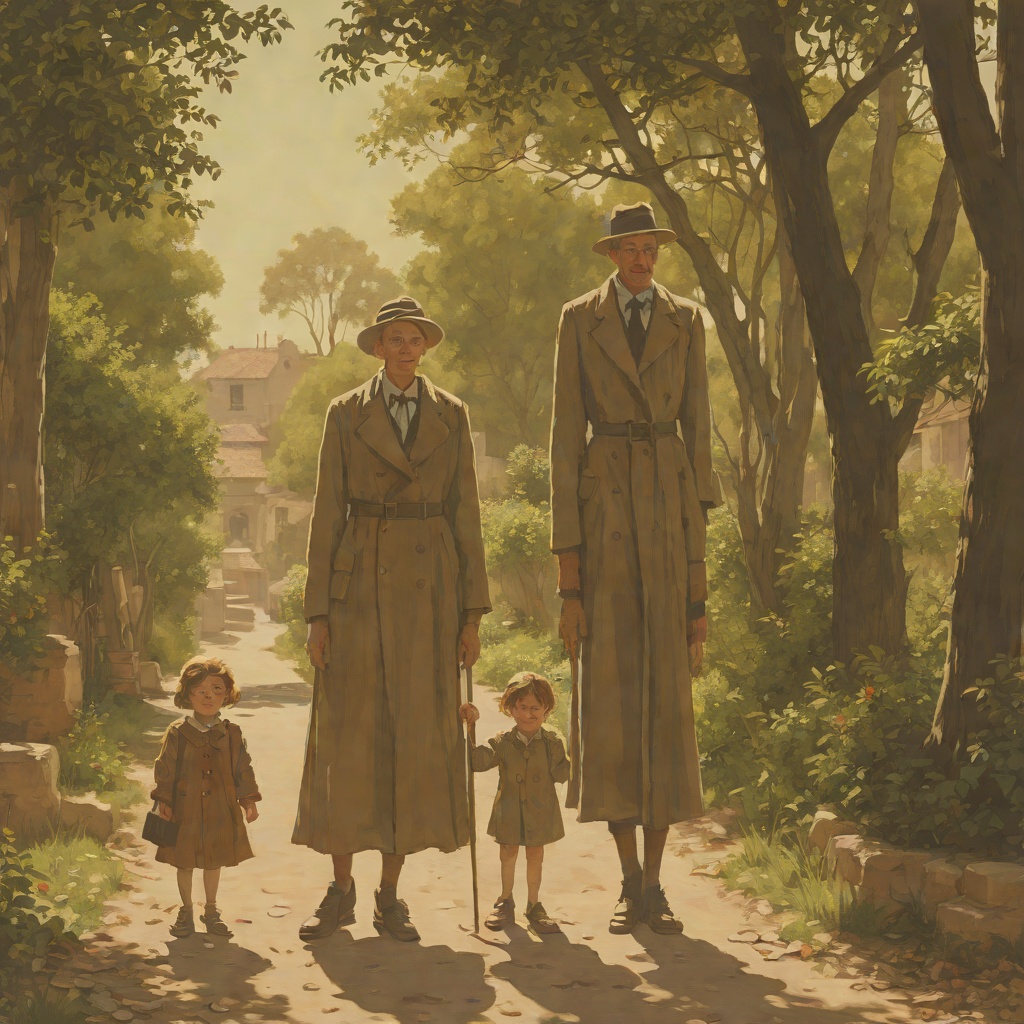
Harold Fry's father's dementia
The Unlikely Pilgrimage of Harold FryHarold Fry's father's dementia is the terminal illness that shadows Harold's pilgrimage, transforming his walk to Berwick-upon-Tweed into a confrontation with a family history of abandonment, alcoholism, and loss. The father's decline—from a war-returned alcoholic who never wanted a child, to a man who expelled Harold on his sixteenth birthday, to a nursing-home patient who no longer recognizes his son—becomes the template for Harold's deepest fear that he is 'going the same way.' The dementia functions as both a literal diagnosis and a narrative mirror: it is the condition Maureen believes she recognizes in Harold's early forgetfulness, the haunting image of a small man throwing teaspoons that Harold cannot escape, and the catalyst that forces him to measure his own life against his father's fate.
The Father's Decline and the Family History
The father's dementia is inseparable from the larger story of his life, which Harold's wife Maureen recounts to the locum doctor when she fears her husband is succumbing to the same illness. The father had returned from the war an alcoholic, prone to depression, and the parents had not wanted a child. Harold's mother packed her suitcase and never returned, leaving the father to take up with a succession of women until he showed Harold the door on his sixteenth birthday. After that, the two men remained estranged for many years, until a woman rang Harold out of the blue, claiming to be his stepmother, and said, 'You'd better fetch your father; he's mad as a hatter.' This was the Alzheimer's. Harold found his father a nursing home, but the man was dead before he was sixty. They visited several times, but the father shouted a lot and threw things, and had no idea who Harold was.
The Haunting Image of the Nursing Home
The nursing-home visits left Harold with a recurring image that would pursue him across England. On one visit, the carer said, 'Say hello to your son,' and catching sight of Harold, the father had begun to shake. On the last visit, the carer had Harold by his jacket sleeve, almost tugging him out of range, saying, 'But he seems disturbed. Maybe you had better leave it for today.' Glancing over his shoulder as he hurried away, Harold's final impression had been of a small man throwing teaspoons and yelling he had no son. This image—the small man, the thrown teaspoons, the denial of paternity—becomes one of the memories Harold most fears, one he is normally so good at repressing. It resurfaces with particular force as he walks, and it is the memory he relives when he tries to explain his life to Kate, the pilgrim who asks him about his past.
Maureen's Fear and the Diagnosis of Harold
The dementia also operates as a diagnostic lens through which Maureen views her husband. When Harold leaves on his walk, Maureen tries to distract herself with the Telegraph crossword, only to discover he has filled in all the easy answers. A terrible thought rushes into her head: maybe her secret fears are confirmed, maybe he will end up with Alzheimer's like his father. The man was dead before sixty. When she later visits the locum, she gives a brief account of Harold's history—the alcoholic father, the mother who left, the sixteenth-birthday expulsion—and insists, 'It's in his family. I recognize the signs.' The locum asks whether Harold substitutes words with inappropriate ones, forgets entire conversations, leaves things in strange places, or suffers rapid mood swings. Maureen's fear is not merely medical; it is the terror that her husband is repeating his father's trajectory, that the man she married is disappearing into the same oblivion.
The Father's Dementia and Harold's Self-Understanding
For Harold, the father's dementia becomes a measure of his own life and a spur to his pilgrimage. As he walks, he measures distance not in miles but with his remembering, and the past he has spent twenty years seeking to avoid chatters and plays through his head with a wild energy. He recalls lying in his bed as a teenager, hearing the hollow cackle of a crow in the silence, and being overwhelmed with loneliness—the same loneliness that defined his father's house. The fear of becoming his father is so strong that when he looks in a mirror during his walk and sees a haggard, burnt face covered in sharp stubble like pinheads, all he can picture is his father in the nursing home, with his slippers on the wrong feet. Yet the walk also offers him a different path. He comes to understand that in order to succeed he must remain true to the feeling that inspired him in the first place, and that it is important to allow himself to be true to the instincts that made him Harold, as opposed to anyone else—including, implicitly, his father.
The Father's Legacy in Harold's Confession
The dementia's deepest legacy emerges in Harold's confession letter to the garage girl, where he connects his father's fate to his own failures as a father. He writes that twenty years ago he buried his son, David, who hanged himself in the garden shed. He describes how his wife took it terribly, wouldn't leave the house, put up net curtains because she didn't want the neighbours prying, and began talking to David as if he were still with her. Harold admits that he was drinking, keeping bottles in paper bags under his desk, and that when he was really out of it one night, he dismantled the garden shed, and then broke into the brewery and did something terrible. Queenie knew it had to be him and took the blame. The father's dementia hovers over this confession as the original wound: the man who threw teaspoons and yelled he had no son produced a son who, in turn, failed his own son. The pilgrimage is Harold's attempt to break that chain, to walk toward a redemption his father never found.
The Father's Dementia and the Shape of the Pilgrimage
The father's dementia ultimately shapes the very structure of Harold's journey. It is the fear that drives Maureen to imagine Harold lying in the road with his mouth open, and it is the reason she initially cannot bear to speak to David, afraid that if she did she would miss him and it would be more hurt than she could bear. It is also the condition that makes Harold's walk legible to the strangers he meets: when he tells the story about Queenie and the garage girl, and asks strangers if they would be so good as to help, he is offering them a narrative of hope against the background of his family's despair. The dementia is the negative image of the pilgrimage itself—a slow, involuntary forgetting versus a deliberate, physical remembering; a man confined to a nursing home versus a man walking the length of England; a father who threw teaspoons and denied his son versus a father who walks six hundred miles to save a friend. In this contrast, the dementia becomes more than a medical condition; it is the fate Harold is walking away from, and the fate he must understand in order to become, at last, himself.